


In Her Mind



In Her Mind is an original performance, which questions the extent to which we follow and understand authority. Revolving round the imaginations of two children, who are inspired by the authoritative figures they see on TV as well as their parents, teachers, peers and other adult figures, their thoughts are recorded periodically on a whiteboard. The audience are taken on a journey of authority throughout an individual’s life as the children dress up as television presenters, teenagers and adults, imagining what life is like for them. Meanwhile, a more realistic depiction of these characters creates an alternative layer, allowing the audience to be able to place themselves within the performance and reflect on their own opinions of authority. This playful take on hierarchy invites the audience to wonder, without dictating, why we just blindly follow and if it is better or worse if we do.
Influences


Forced Entertainment
Our performance blended playfulness with serious and thought-provoking material. This can also be seen in the work of the Sheffield-based theatre group Forced Entertainment. One particular performance is Nights in this City. Audiences were taken on a guided bus journey of Sheffield, past ‘the Leaning Tower of Pisa’, ‘Venice’ and ‘Berlin’(1) - a variety of wildly inaccurate locations. This 'poetical and mischievous'(1) performance finished with a massive installation (see left). A long piece of text, written in chalk on the floor of a 'found space'(1). Our performance also aimed to have a 'finished' aspect, which the audience can view at the end of the performance: the whiteboard. Like Nights in this City, this aspect is only revealed at the end, giving the audience a chance to reflect on what they have seen and what they are seeing now.

We also wanted to make the imagined characters exaggerated to further present the idea that the performance was inside the minds of these children. In many of Forced Entertainment's performances, such as Signal to Noise or Quizoola, costume is used to exaggerate or explain a character. In In Her Mind, there were several costume changes and although these may be subtle, by making the fit of the clothes slightly off, the characters - particularly the news reporters, who appear at different points throughout the performance - seemed hyperbolised or full of themselves in their too-big attire.
In Signal to Noise, ‘what’s real life and what’s just pretending is never far away’(2). In In Her Mind, the idea of the real and imagined world were also only separated by a thin veil, represented by lighting changes and costume. This allowed the audience to see through, into their imagined world, as the children dress up as these exaggerated characters. Therefore, an audience could draw connections between the imagined world and the real one.


Jack Britton
One performance in particular that inspired us was Jack Britton’s I Used To Hear Footsteps, in which Britton used a blackboard to display his account of the haunting of his childhood home. We were initially inspired by the visual aspect of his piece, such as the idea of the centre piece being a blackboard, in which 'layer after layer'(3) of chalk is 'covered over and added to'(3).
Similarly to Britton, we used a whiteboard to display information to an audience in the same messy, frantic way. However, we did not use it for one specific purpose (e.g. writing down findings). Instead, we wrote to provide context to the audience for the scene as well as the performance as a whole. Our aim was not to make the whiteboard make sense to just anyone at the end. You would only understand it if you had been an audience member, who had watched the whole show and seen it come together bit by bit. In doing this, we aimed to make the performance more personal, so that the audience becomes aware of the two different outlooks on authority we portray and can decide which they perceive is best for them, without us dictating what is 'right'.


Quizoola
Signal To Noise
Nights In This City Final Installation
I Used To Hear Footsteps
Britton’s piece is autobiographical, reflecting his own experience in a haunted house. Though our performance did not lean into this element as heavily, we were inspired by it in the creation of our characters, with their opinions reflecting our own thoughts and interests. While our performance itself is political, our playful take on it comes from our own outlook on a more serious topic. We aimed to engage the audience with this playfulness, while simultaneously presenting them with the two perspectives.

Audience Experience


I Used To Hear Footsteps
While rehearsing, we experimented with having the audience in various formations, such as a horseshoe shape, which created an intimate atmosphere, perfect for immersing the audience, or having the audience follow us around the stage as we moved from set station to set station, so that they can see more clearly what we are writing on the whiteboard. However, both came with complications, whether that be putting the audience at risk with a messy set or creating the wrong atmosphere for certain parts of the performance.
In the end, we decided that traditional end-on staging would work best, practically, in our performance. The idea of there being a hierarchy and 'rules' in theatre, considering the audience must sit silently and in darkness, would also contribute to our theme of authority. The final result of our performance is revealed when the whiteboard is turned around and the newspaper cut outs and drawings of authoritative figures are presented. We placed a spotlight on this and allowed the audience to sit with it for a moment, observing, from a distance. As the performance ends, and the audience have viewed the two outlooks on society, they are left with two options:


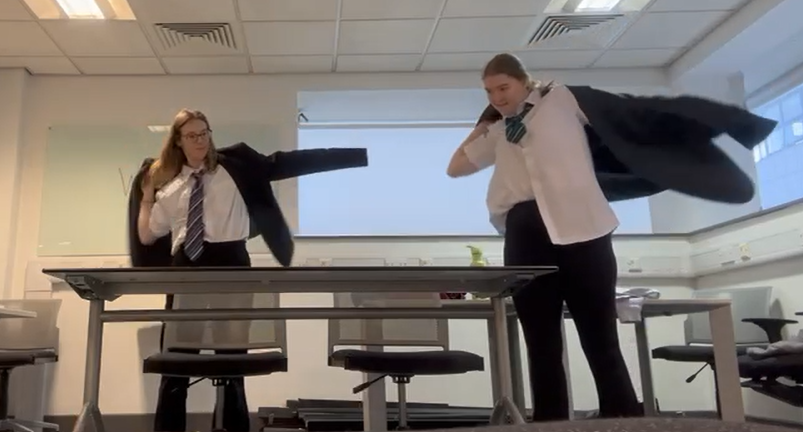


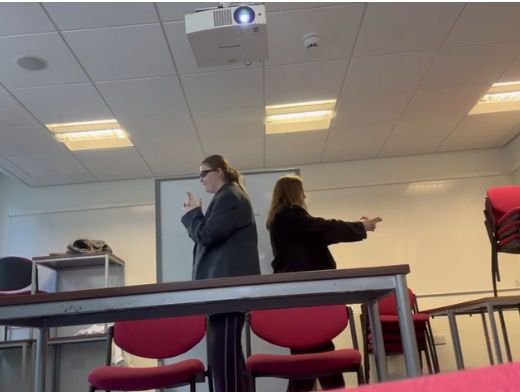


At the very beginning of the process, being in a pair made it difficult to find material that worked. We struggled slightly to maintain the same enthusiasm for the idea that we had when we originally thought of it. Therefore, when rehearsing, we found warming up by improvising, and overall not taking ourselves too seriously, massively benefitted the playful nature and creation of our performance. Aided by these games, we found our creativity and freedom to experiment came more quickly to us. Additionally, the games created a friendlier and more comfortable environment. Because of the nature of improvisation, we made many mistakes in the warm-up, meaning I always felt comfortable sharing ridiculous ideas when rehearsing!
Though not everything we said made it into the final performance, sometimes even a small part of one idea was workshopped to fit the bigger picture, or inspired a new direction, which was especially helpful when we inevitably got stuck for ideas.
Similarly, I found it was important to be excited about the performance. When I am devising, I can sometimes spend an unnecessary amount of time worrying about the final performance, which can mute my passion for the piece. Remembering how enthusiastic I was when we first came up with our idea helped bring the fun and enjoyment back into rehearsals.
Overall, I think the strongest moments of our final performance came from the energy we put into performing it. The audience were amazing on the day that we performed, but, still, I was pleasantly surprised when we got a few laughs out of them.
If we had more time, we could further develop the staging to make it more visually appealing for an audience. We saw many beautiful sets that day that added to the performance without detracting from the message, and I think adding something visually appealing that we can interact with, like a set of bars above the stage could do this, as well as adding another layer of dynamism to our performance. These would work well in adding to our movement sequences, because levels could further show the growing disconnection between the two children, as well as reinforcing the playful atmosphere that underlies our whole piece.
Having spoken with members of the audience afterwards, the one main point of improvement seemed to be making our message clearer. If we had more time, we would develop the opening sequence to further emphasise the message at the end. Additionally, we focussed on the general message of authority and conflict in the world. I think we could refine that more, either to a specific situation or time period, so that the audience can fully comprehend what we are trying to say.
Having created this performance, my thinking around devising has developed in a positive way, particularly in finding my own style of devising and a way of rehearsing that worked for me. Now that I know this, I will be able to adapt this in the future so that I can make it work with any project or with any group of people.
Reference List:
1 - Forced Entertainment (n.d.) Nights In This City. Retrieved April 29, 2026. https://www.forcedentertainment.com/projects/nights-in-this-city/
2- Forced Entertainment (n.d.) Signal To Noise. Retrieved May 3, 2026. https://www.forcedentertainment.com/projects/signal-to-noise/
3 - Hutchins, R (2016, August 30) I Used To Hear Footsteps Review. Fringe Review. https://fringereview.co.uk/review/edinburgh-fringe/2016/i-used-to-hear-footsteps/

Rehearsal Process

Reflection
